
The Future of Artificial Intelligence in Everyday Life
The future of artificial intelligence is already unfolding in ordinary moments: the phone that unlocks when it sees your face, the map that reroutes you around traffic, the bank that blocks a suspicious payment before you notice it. Artificial Intelligence (AI) is no longer a futuristic concept. It has become an integral part of modern life, influencing industries, businesses, and personal experiences.
From smart assistants to recommendation systems, AI is helping people make faster and more informed decisions. Over the next few years, it will move from answering questions to quietly completing tasks on our behalf.
This article looks at where AI already shows up in daily life, the nine biggest shifts ahead, what they mean for businesses in India, the UAE and beyond, and the challenges that will shape how responsibly it all develops.
Table of contents
- How AI Is Changing Daily Life Today
- 9 Shifts That Will Shape the Future of Artificial Intelligence
- A Day in 2030: The Future of Artificial Intelligence at Home
- The Future of Artificial Intelligence in India
- The Future of Artificial Intelligence in the UAE
- What the Future of Artificial Intelligence Means for Businesses
- Benefits of AI
- Challenges and Considerations
- Common Myths About the Future of Artificial Intelligence
- How to Prepare for the Future of Artificial Intelligence
- The Road Ahead
- Frequently Asked Questions
- Conclusion
How AI Is Changing Daily Life Today
AI-powered applications are everywhere. Smartphones use AI for voice recognition, cameras use AI to improve image quality, and streaming platforms use AI algorithms to recommend content based on user preferences.
Much of this happens without a label. A few examples most people use every day:
- Navigation – map apps predict traffic and arrival times from millions of journeys, then suggest faster routes in real time.
- Payments – banks and payment apps score each transaction for fraud risk in milliseconds, which matters at the scale of UPI in India.
- Email and messages – spam filters, smart replies and autocomplete all rely on language models.
- Shopping – product recommendations, search results and delivery estimates are tuned by machine learning.
- Photos – phones sharpen low-light shots, blur backgrounds and group pictures by face or place.
- Language – instant translation of signs, menus and conversations, including between Indian languages.
These everyday uses are the foundation for what comes next. The future of artificial intelligence builds on them by connecting separate tools into systems that understand context and act across apps.
9 Shifts That Will Shape the Future of Artificial Intelligence
The changes below are already visible in early products. Over the next few years they are likely to become normal parts of daily life. Together they show that the future of artificial intelligence is less about one breakthrough and more about many useful improvements arriving at once.
1. Assistants That Complete Tasks, Not Just Answer Questions
Today’s assistants mostly reply. The next generation, often called AI agents, will take actions: comparing insurance quotes, booking a doctor’s appointment around your calendar, or filling in a form using details you have approved. The key change is delegation, with people setting goals and limits while the assistant handles the steps.
2. More Personal and Preventive Healthcare
AI already helps doctors read scans, flag risks in test results and manage appointment schedules. Wearables track heart rhythm, sleep and activity, and can prompt users to seek care earlier. The future of artificial intelligence in healthcare is about support rather than replacement: faster triage, fewer missed signals and more time for doctors to spend with patients.
3. Learning That Adapts to Each Student
AI tutors can explain the same idea in several ways, notice where a student is struggling and set practice at the right level. For students in smaller towns, this can mean access to patient, personalised help in their own language. Teachers gain time for the parts of teaching that need a human, such as motivation and mentoring.
4. Smarter Homes and Lower Energy Use
Connected homes will learn routines, adjusting lighting, air conditioning and appliances to save power without constant manual control. In hot climates such as the UAE and much of India, smarter cooling alone could make a meaningful difference to household bills.
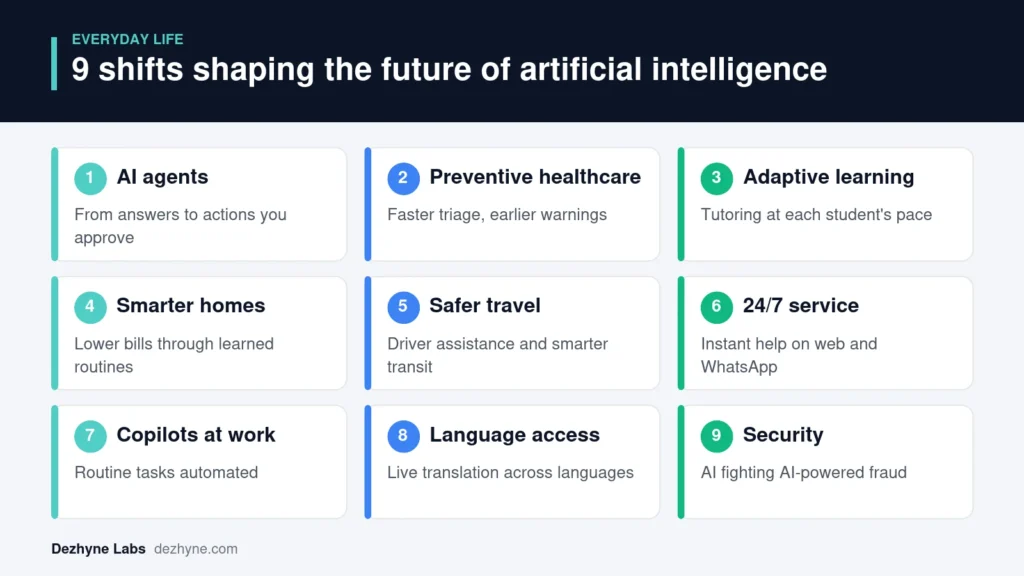
5. Safer and Easier Travel
Driver-assistance features such as lane keeping, adaptive cruise control and automatic braking are spreading to more affordable cars. Public transport systems use AI to predict demand and plan routes. Fully driverless cars will arrive unevenly, but assistance that prevents accidents is already here.
6. Customer Service That Never Sleeps
Customers increasingly expect instant answers on websites and WhatsApp at any hour. AI chat assistants can answer common questions, check order status and book appointments, then hand complex issues to a human with the full context. Done well, this improves service rather than hiding the people behind it.
7. Copilots at Work
Writing drafts, summarising meetings, analysing spreadsheets and generating code are becoming everyday tasks shared with AI. The future of artificial intelligence at work is less about replacing jobs outright and more about changing what each job involves, with routine parts automated and judgement, relationships and creativity becoming more valuable.
8. Language and Accessibility for Everyone
Speech recognition, live captions and translation are breaking down barriers for people with disabilities and for speakers of less-served languages. Projects such as India’s Bhashini initiative aim to make digital services usable across many Indian languages, which could bring millions more people online in a meaningful way.
9. Stronger Security, and Smarter Threats
AI helps banks and businesses detect fraud and cyber attacks faster. The same technology also helps criminals write convincing scam messages and create fake voices or videos. Expect more verification steps, more education about deepfakes, and security tools that use AI to fight AI.
A Day in 2030: The Future of Artificial Intelligence at Home
Predictions are easier to judge when they are concrete, so here is a realistic scenario rather than science fiction. Every piece of it already exists in some form today.
Priya wakes in Chennai to a summary of her day read aloud in Tamil: two meetings, a reminder that her father’s prescription needs refilling, and a note that rain is expected after four. Her assistant has already requested the refill from the pharmacy she approved last month and suggests leaving for her afternoon meeting twenty minutes early.
At work, her team’s copilot drafts the weekly report from their CRM, and she spends the saved hour with a client. In the evening, her son’s maths tutor app notices he keeps slipping on fractions and switches to a visual explanation. The air conditioner has been pre-cooling the flat to match their usual arrival time, using cheaper off-peak power.
None of this feels dramatic, and that is the point. The future of artificial intelligence will feel less like talking to a robot and more like everyday services that simply work better together.
The Future of Artificial Intelligence in India
India brings scale that few countries can match: hundreds of millions of smartphone users, a digital payments system used daily across the country, and a large pool of engineering talent. Public digital infrastructure such as Aadhaar, UPI and DigiLocker gives AI services a foundation to build on.
The government’s IndiaAI Mission, approved in 2024, aims to expand computing capacity, datasets and AI skills, with a focus on applications in areas such as agriculture, healthcare and education. Language is a particular opportunity, since tools that work well in Hindi, Tamil, Bengali and other Indian languages can reach people English-first services have missed.
For Indian businesses, the future of artificial intelligence is likely to arrive first through practical tools: WhatsApp assistants, vernacular voice support, smarter lending and logistics. Companies that combine local market knowledge with these tools will have a clear advantage.
The Future of Artificial Intelligence in the UAE
The UAE has made AI a national priority for years. It appointed the world’s first Minister of State for Artificial Intelligence in 2017 and set out a National Strategy for Artificial Intelligence 2031. Abu Dhabi is home to the Mohamed bin Zayed University of Artificial Intelligence, one of the first graduate universities dedicated to the field.
Government services in the UAE are already highly digital, and AI is being applied to areas such as transport, energy and public services. For businesses operating there, customers increasingly expect fast, digital and multilingual service in Arabic and English. Preparing for the future of artificial intelligence in the Gulf means meeting those expectations while respecting local data rules.
What the Future of Artificial Intelligence Means for Businesses
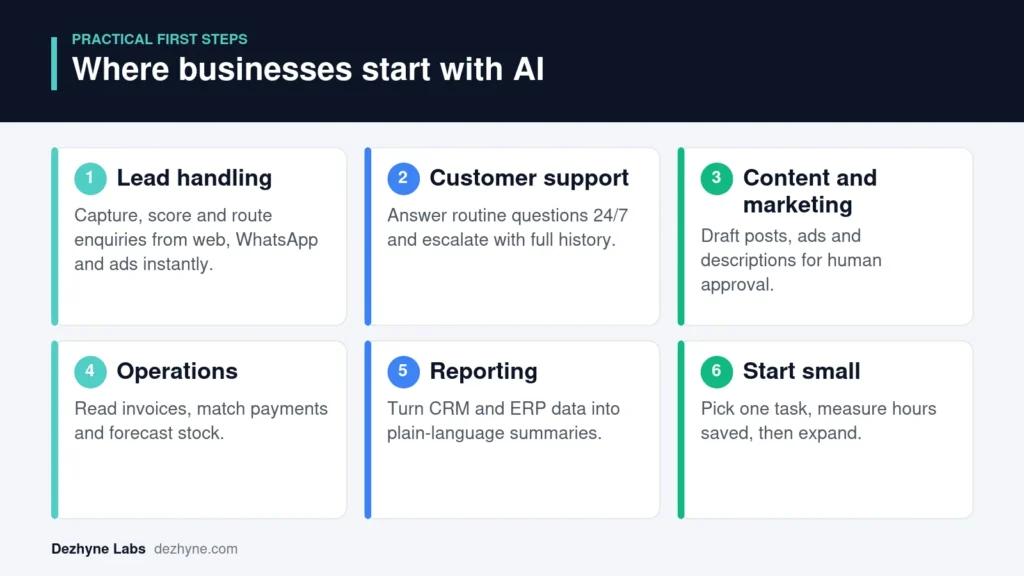
For businesses, the practical question is not whether AI matters but where it saves time or wins customers first. Small and mid-sized companies do not need research labs to benefit. Most of the value comes from applying proven tools to everyday workflows:
- Lead handling – capturing enquiries from the website, WhatsApp and ads, scoring them and routing them to the right salesperson instantly.
- Customer support – answering routine questions automatically and escalating complex ones with full history.
- Content and marketing – drafting posts, ad variations and product descriptions for human review and approval.
- Operations – reading invoices, matching payments, forecasting stock and flagging exceptions.
- Reporting – turning CRM and ERP data into plain-language summaries for managers.
The businesses that benefit most start small, measure the time or revenue impact, and expand from there. Clean data matters more than the choice of AI model, which is why connected systems such as a well-implemented CRM and ERP are often the first step. Visibility matters too: as more people ask AI assistants for recommendations, a clear and well-structured business website becomes the source those assistants read.
Benefits of AI
- Increased productivity through automation of repetitive work.
- Improved decision-making using data analysis and forecasting.
- Enhanced customer experiences with personalized services and faster responses.
- Better healthcare through predictive diagnostics and earlier warnings.
- Wider access to education, information and services in local languages.
- Fewer errors in tasks such as data entry, reconciliation and quality checks.
These benefits compound. Time saved on routine tasks can be spent on customers, products and ideas, which is where most of the long-term value of the future of artificial intelligence will come from.
Challenges and Considerations
Despite its advantages, AI presents challenges such as data privacy concerns, ethical considerations, and the need for responsible implementation. Organizations must ensure transparency and fairness when deploying AI solutions.
The main issues to watch are:
- Privacy – AI systems learn from data, so how personal information is collected, stored and used matters. India’s Digital Personal Data Protection Act, 2023 sets clear duties for businesses handling personal data.
- Bias – models can reflect unfair patterns in the data they learned from, affecting decisions on loans, hiring or insurance.
- Accuracy – AI can produce confident but wrong answers, so important outputs need human review.
- Misinformation – realistic fake images, audio and video make verification more important than ever.
- Jobs and skills – some tasks will disappear while new roles appear, and people will need support to reskill.
- Regulation – governments are setting rules, from the European Union’s AI Act to national AI strategies in the UAE and India.
International bodies have also published shared guidance. The OECD AI Principles are a useful summary of what trustworthy AI should look like, covering transparency, accountability, safety and respect for human rights.
Common Myths About the Future of Artificial Intelligence
Headlines tend to swing between excitement and fear. A calmer view helps people and businesses make better decisions.
- “AI understands the world like a person does.” Current systems are very good at recognising patterns in data. They can be impressive and still make basic mistakes a child would not, which is why human review remains important.
- “AI is only for big tech companies.” Many useful tools are affordable or free, and small businesses often see faster returns because their processes are simpler to automate.
- “AI will take every job.” Past waves of automation changed work more than they ended it. Tasks will shift, and the need for people who can use these tools well is growing.
- “Once AI is set up, it runs itself.” Models need good data, monitoring and updates. Treat an AI system like any other important process that needs an owner.
Separating myth from reality makes the future of artificial intelligence easier to plan for, whether you are choosing a phone, a course or a business system.
How to Prepare for the Future of Artificial Intelligence
Preparing does not require technical expertise. It mostly requires curiosity and a few good habits.
For Individuals
- Try mainstream AI tools for real tasks, such as summarising a document or planning a trip, to learn their strengths and limits.
- Check important facts from AI against trusted sources before acting on them.
- Review app permissions and privacy settings, especially for voice and location data.
- Learn to spot deepfakes and AI-written scams, and agree on a family code word for urgent money requests.
- Build skills that complement AI: communication, judgement, problem solving and domain knowledge.
For Businesses
- List the repetitive tasks that consume the most staff hours and start with one.
- Get your data in order, because AI is only as useful as the information it can read.
- Set clear rules on what data may be shared with AI tools and who reviews outputs.
- Measure results in hours saved, faster responses or extra revenue, not just adoption.
- Train your team so AI becomes a shared tool rather than a source of anxiety.
Our team at Dezhyne Labs helps businesses take these first steps with practical AI automations, chat assistants and connected systems. You can explore what we do or talk to us about where AI could save your team the most time.

The Road Ahead
As technology continues to evolve, AI will play an even greater role in shaping the future. Businesses that embrace AI responsibly can unlock new opportunities, improve efficiency, and create innovative products and services.
Progress will not be smooth or even. Some predictions will arrive faster than expected, others more slowly, and a few will turn out to be wrong. Anyone who claims to know the exact future of artificial intelligence should be treated with caution. The direction is clear, though: AI will become less visible as a separate tool and more woven into the apps, devices and services people already use.
Frequently Asked Questions
What is the future of artificial intelligence in everyday life?
AI will increasingly act on our behalf, booking, comparing, translating and reminding, while staying in the background of familiar apps. The future of artificial intelligence in daily life is about convenience, personalisation and better access to services, balanced by stronger rules on privacy and safety.
Will AI replace human jobs?
AI will automate many tasks within jobs rather than whole professions. Roles will change, some will shrink and new ones will appear. People who learn to work alongside AI tools are likely to be in the strongest position.
Is AI safe to use?
Mainstream AI tools are safe for many everyday tasks when used sensibly. Avoid sharing sensitive personal or business data without checking the provider’s privacy terms, and verify important answers before relying on them.
How can a small business start using AI?
Pick one repetitive, measurable task, such as answering common customer questions or following up website leads, and automate it with a proven tool. Measure the results for a month, then expand to the next task.
Conclusion
Artificial Intelligence is transforming the world at an unprecedented pace. Understanding its capabilities and limitations is essential for individuals and organizations looking to thrive in the digital era.
The future of artificial intelligence will not arrive as a single breakthrough. It will arrive as hundreds of small improvements to how we travel, learn, shop, work and stay healthy. The people and businesses that start learning now, carefully and responsibly, will be best placed to benefit from it.