
Why Your Business Website Matters in the Age of AI Search

Imagine this: A potential customer needs your service. Instead of typing into Google, they open ChatGPT and ask, “What’s the best accounting firm near me?” The AI responds with three recommendations, but your business isn’t one of them. Why? Because you don’t have a business website.
This isn’t a hypothetical scenario anymore. It’s happening right now, millions of times a day. AI-powered search tools like ChatGPT, Perplexity, and Google’s AI Overview are fundamentally transforming how people discover businesses. If you thought having a business website was optional in 2026, think again.
In this post, you’ll learn why your business website has become more critical than ever, how AI search is reshaping customer discovery, and what you need to do to ensure your business stays visible in this new landscape.
Table of contents
- The Seismic Shift: How People Search Has Changed Forever
- Why “Just Having Social Media” Isn’t Enough Anymore
- How AI Tools Actually Discover and Recommend Businesses
- What Happens If You Don’t Have a Website in 2026?
- What Makes a Business Website “AI-Ready” in 2026?
- Structured Data Every Business Website Should Have
- Write Business Website Content That AI Can Quote
- Your Google Business Profile and Website Work Together
- The Bottom Line: Your Website Feeds Everything
- 7 Fixes That Make a Business Website Ready for AI Search
- How to Check What AI Says About Your Business
- Frequently Asked Questions
- Next Steps: Getting Started
The Seismic Shift: How People Search Has Changed Forever
The Numbers That Should Worry You
The search landscape has undergone a dramatic transformation. ChatGPT now commands over 60% of the AI search market, with Google Gemini and Microsoft Copilot trailing behind. Together, these three platforms control nearly 89% of AI-driven searches, and their influence is growing exponentially.
Even more striking: over 93% of searches in Google’s AI Mode end without a single click to any website. Traditional Google searches with AI Overviews see 43% zero-click rates. This means users are getting answers directly from AI without ever visiting your competitors’ websites, or yours.
Here’s the reality: AI platforms generated over 1.13 billion referral visits in mid-2025, and that number is accelerating. By 2027, AI-driven search is projected to generate as much global economic value as traditional search engines.
What This Means for Your Business
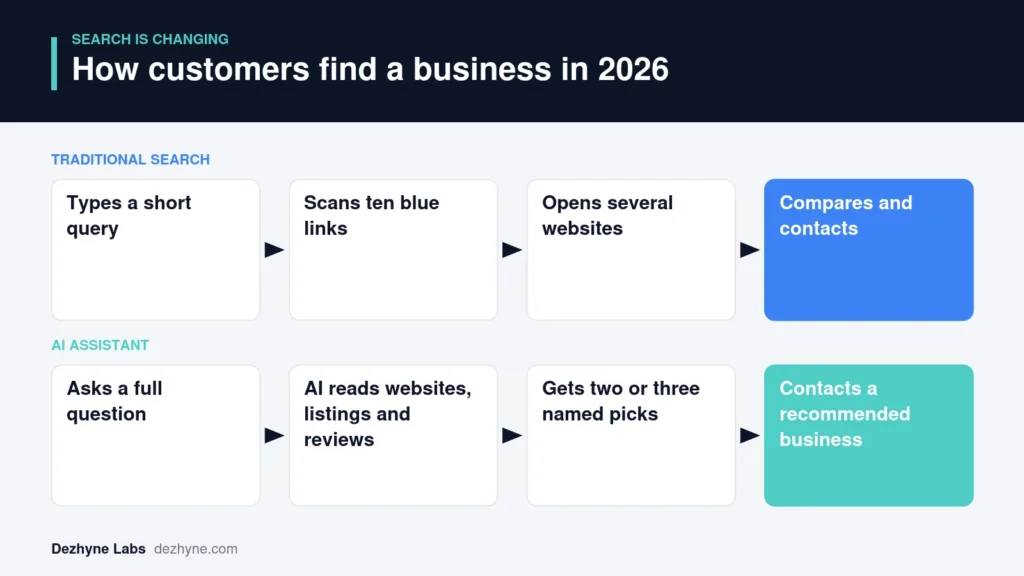
When someone asks an AI chatbot, “Who should I hire for kitchen remodeling?” they’re not looking through ten blue links. They want a direct, conversational answer, ideally with specific recommendations.
These queries are longer and more conversational than traditional searches. Instead of typing “plumber Chicago,” users ask complete questions: “Can you recommend a reliable plumber in Chicago who handles emergency repairs?” The AI then synthesizes information from across the web and provides curated recommendations.
If your business isn’t structured to be discovered by these AI tools, you’re invisible to this growing segment of customers.
Why “Just Having Social Media” Isn’t Enough Anymore
Many business owners believe their Instagram page or Facebook profile is sufficient for online presence. While social media plays a role in your marketing mix, it’s fundamentally unreliable as your primary digital presence.
The Problem with Rented Land
Social media platforms are rented real estate. Algorithm changes can tank your reach overnight. Platforms can change their rules, increase advertising costs, or even shut down accounts without warning. You’re building your business on land you don’t own.
More importantly, AI search tools don’t crawl your Instagram posts to make recommendations. They look for structured, authoritative information, the kind found on websites.
Your Business Website: The Digital Foundation
A website is the only digital asset you truly own. You control the content, the structure, and the narrative. When ChatGPT evaluates which businesses to recommend, it looks for signals of credibility, expertise, and up-to-date information, all elements best showcased on a professional website.
Your business website serves as the central hub that feeds all other channels: your Google Business Profile, social media, email marketing, and now, AI discovery platforms. Without this foundation, everything else is built on sand.
How AI Tools Actually Discover and Recommend Businesses
Understanding how AI search works is critical to positioning your business for success.
Your Website is AI’s Source of Truth
When ChatGPT or Perplexity considers recommending your business, it’s building an authority profile based on multiple signals:
Structured Content: AI tools favor websites with clear headings, well-organized information, and logical structure. A properly formatted website with H1, H2, and H3 tags helps AI understand what you do and who you serve.
Third-Party Validation: Being mentioned on reputable websites, industry publications, and professional directories signals credibility. AI platforms increasingly factor in who is talking about you, not just how often.
Fresh, Updated Information: Websites with regularly updated content demonstrate that your business is active and current. Stale websites raise red flags.
Expertise Signals: Blog posts answering customer questions, case studies showcasing results, and detailed service descriptions all contribute to AI’s assessment of your expertise.
The Quality Traffic Advantage
Here’s something remarkable: while overall click-through rates are dropping, the traffic that does come from AI search converts at dramatically higher rates. Studies show AI search traffic converts at 14.2% compared to traditional Google’s 2.8%, over five times better.
Why? Because AI pre-qualifies users. When ChatGPT recommends your business, it’s already determined you’re a good fit for that user’s specific needs.
What Happens If You Don’t Have a Website in 2026?
The consequences of remaining website-less are more severe than ever.
The Invisibility Problem
Without a business website, you simply don’t exist in the AI recommendation ecosystem. When potential customers ask AI tools for recommendations in your industry, you won’t appear. Your competitors who invested in websites will capture those customers instead.
This creates a compounding disadvantage. The businesses getting recommended gain more customers, more reviews, and more online mentions, which makes AI tools even more likely to recommend them in the future.
The Trust Gap
Modern consumers expect legitimate businesses to have websites. When evaluating options, the absence of a business website raises immediate questions: Is this business professional? Are they established? Can I trust them?
A website provides verification. It shows you’re invested in your business, transparent about your services, and accessible to customers. Social media alone doesn’t convey the same level of credibility.
What Makes a Business Website “AI-Ready” in 2026?
Not all websites are created equal in the AI era. Here’s what you need to optimize for AI discovery:
Essential Content Elements
Clear Service Descriptions: Use descriptive headings and detailed explanations of what you offer. AI tools need explicit information to understand your business.
Location Information: For local businesses, clearly state your service areas. AI frequently fields location-specific queries.
Customer Testimonials: Social proof helps AI assess your reputation and reliability.
Regular Content Updates: A blog or news section demonstrating ongoing expertise signals that you’re active and authoritative.
Technical Must-Haves
Mobile Responsiveness: Most searches happen on mobile devices. A mobile-friendly website is non-negotiable.
Fast Loading Speed: Both users and AI crawlers favor fast websites.
SSL Security: HTTPS is now standard and expected by both search engines and AI tools.
Structured Data: Schema markup helps AI understand your content’s context and meaning.
Content That Gets Cited
Research shows specific content formats perform better with AI tools:
- Comparison tables: Pages with three or more comparison tables earn 25.7% more AI citations
- List formats: Structured lists with clear sections increase citation rates by up to 26.9%
- Concise writing: Pages averaging 10 words or fewer per sentence get cited 18.8% more often
The pattern is clear: organized, scannable, well-structured content wins in the AI era.
Structured Data Every Business Website Should Have
Structured data, also called schema markup, is a small block of code that labels the facts on a page so machines do not have to guess. It does not change how the page looks to visitors. For most companies, these types cover the essentials of a business website:
- Organization or LocalBusiness – your official name, logo, address, phone number, opening hours and social profiles.
- Service – each service you offer, the area you serve and who provides it.
- FAQPage – questions and answers that appear on the page, marked up as such.
- Article – author, publish date and update date for blog posts and guides.
- BreadcrumbList – where each page sits in your site structure.
- Review or AggregateRating – genuine reviews shown on the page, where the guidelines allow.
On WordPress, an SEO plugin can generate most of this automatically once your business details are filled in correctly. Test your pages with Google’s Rich Results Test after any change to make sure the markup is valid.
Write Business Website Content That AI Can Quote
AI assistants summarise. The easier your page is to summarise accurately, the more likely it is to be used. Compare these two sentences:
- Hard to quote – “We deliver innovative, world-class digital solutions that empower businesses to unlock their true potential.”
- Easy to quote – “Dezhyne Labs is a Chennai-based agency that builds websites, runs digital marketing and sets up CRM systems for businesses in India and the UAE.”
The second sentence answers who, what and where in plain words. Apply the same approach across your business website: lead each page with a direct answer, use specific numbers and place names, keep sentences short, and put the most important fact first in every section.
Your Google Business Profile and Website Work Together
For local businesses, your Google Business Profile and your website reinforce each other. The profile helps you appear on Maps and in local results, while the website gives the detail behind it: full service descriptions, pricing guidance, team information and answers to common questions.
Keep the name, address, phone number, hours and categories identical on both. Link the profile to the most relevant page of your business website, not always the home page, and keep posting updates and replying to reviews. AI tools that draw on local data see a consistent, active business rather than conflicting information.
The Bottom Line: Your Website Feeds Everything
The emergence of AI search doesn’t diminish the importance of websites; it amplifies it. Your website is the engine that powers all discovery channels. It’s what AI tools analyze to determine if you’re worth recommending. It’s what Google Business Profile links to. It’s what your social media directs people toward for more information.
This isn’t about choosing between a website and other marketing channels. It’s about recognizing that without the foundation of a professional website, all other efforts are compromised.
The businesses thriving in 2026 aren’t just “online”; they’re strategically positioned to be discovered, evaluated, and recommended by both humans and AI alike.
7 Fixes That Make a Business Website Ready for AI Search
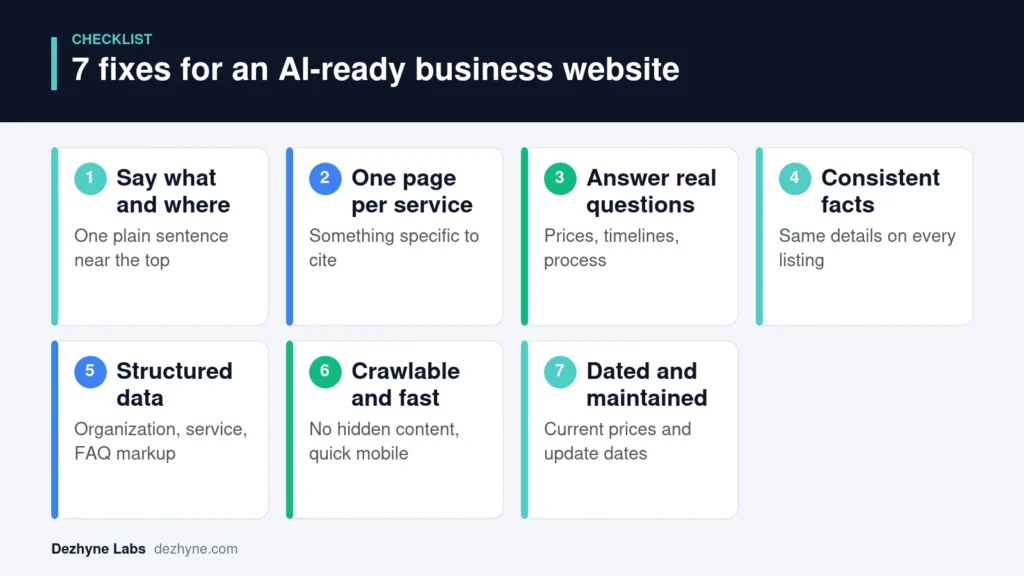
These are the changes that most often decide whether an assistant can quote you accurately. None of them require a rebuild, and all of them help human visitors too.
- Say plainly what you do and where – one sentence near the top of the home page, naming the service and the cities or countries you serve.
- Give every service its own page – a single combined page gives an assistant nothing specific to cite.
- Answer real questions in plain language – pricing ranges, timelines, process and limitations, written the way a customer would ask.
- Keep facts consistent everywhere – the name, address, phone number and hours on your business website should match your Google Business Profile and directory listings exactly.
- Add structured data – organisation, service, article and FAQ markup make the facts on a page machine-readable rather than inferred.
- Stay crawlable and fast – no content locked behind scripts that never render, no blocked resources, and sensible mobile performance.
- Date and maintain your content – visible publish and update dates, current prices, and no abandoned pages contradicting the live ones.
Google describes how its own AI features in Search select and surface content, and the pattern is consistent across assistants: clear, specific, verifiable pages win. A business website that hides its details in images, PDFs or marketing language is simply harder to quote than one that states them.
Treat this as maintenance rather than a project. Review the seven points each quarter, and check what an assistant currently says about you before and after the changes. If you would like help, our website development team builds business website structures of this kind, our digital marketing team handles the content and search side, and you can contact us for a short visibility check.
How to Check What AI Says About Your Business
You can run a simple visibility check in fifteen minutes. Open two or three assistants, such as ChatGPT, Gemini and Perplexity, and ask the questions your customers would ask:
- “Who are the best [your service] providers in [your city]?”
- “What does [your business name] do, and where are they based?”
- “How much does [your service] usually cost in [your city]?”
- “Is [your business name] a good choice for [a specific need]?”
Note whether you appear, whether the facts are correct, and which sources are cited. Wrong opening hours, an old address or a missing service usually point to inconsistent information somewhere online. Fix the source, starting with your own business website, then repeat the check every few months. Over time you will see which changes move the answers.

Frequently Asked Questions
Do I still need a business website if I have a strong Instagram page?
Yes. Social platforms are useful for reach, but you do not own them and AI assistants rarely rely on them for business facts. A business website is the stable, crawlable source that search engines and assistants can read and cite.
Can a small business compete with large companies in AI search?
Often, yes. Assistants answer specific questions, and a small business with clear, local, detailed pages can be the best answer for a specific need in a specific city, even against bigger brands.
How long does it take for website changes to show up in AI answers?
It varies by tool. Search-connected assistants can reflect changes within weeks once pages are recrawled, while answers based on older training data change more slowly. Consistency across your website and listings speeds things up.
Which pages matter most for AI visibility?
Start with the home page, one page for each main service, the about page and the contact page. These are the pages assistants rely on for who you are, what you offer and where you operate. Add an FAQ section to each service page to answer the questions customers ask before they buy.
Should I add an llms.txt file to my business website?
An llms.txt file is a newer proposal for giving AI tools a plain-text summary of your site. It is easy to add and does no harm, but support across major assistants is still uneven. Treat it as a small extra, not a substitute for clear pages, consistent facts and structured data on your business website.
Is an old website better than no website?
An old business website is better than none, but outdated prices, broken links and slow pages can hurt trust and give assistants the wrong facts. Updating the key pages is usually faster and cheaper than a full rebuild.
Next Steps: Getting Started
If you don’t have a business website yet, now is the time to build one. If you have an outdated website, it’s time to modernize it for the AI era.
Start by auditing your current online presence. Search for your business on ChatGPT or Google’s AI Overview. What comes up? What doesn’t? Identify the gaps.
Consider what questions potential customers ask AI about your industry. Make sure your business website answers those questions clearly and comprehensively.
At Dezhyne Labs, we help businesses build and optimize websites designed for both human visitors and AI discovery. In an era where being found means being recommended by intelligent systems, your business website isn’t just a digital brochure. It’s your competitive advantage.
The AI revolution isn’t coming. It’s here. Is your business ready?