---
title: "Website Development Company in United Kingdom"
description: "Website Development Company in United Kingdom Dezhyne Labs is a website development company working with businesses across England, Scotland, Wales and Northern Ireland. Our team is…"
url: "https://dezhyne.com/services/website-development-company-in-uk/"
canonical: "https://dezhyne.com/services/website-development-company-in-uk/"
post_type: "page"
author: "Harimarish Eswaran"
date_published: "2026-10-30T07:14:58+00:00"
date_modified: "2026-11-26T14:19:57+00:00"
extractor: "classic"
---
## 1. Introduction
The way people interact with websites is changing. Traditionally, customers visited websites, browsed pages, compared products, checked prices, and submitted enquiry forms themselves. AI-powered assistants are introducing another way to interact with digital businesses.
Instead of manually navigating multiple websites, users can increasingly rely on AI agents to research products, compare services, check availability, and initiate actions on their behalf.
This shift creates a new requirement: websites should serve human visitors while also providing reliable, structured and permission-controlled access for compatible software agents.
This is where agentic web architecture, Model Context Protocol (MCP), and API-first development become relevant. Businesses planning an API-ready website can explore our [website development services](https://dezhyne.com/services/website-development/). Preparing for the agentic web does not mean every business needs an MCP server or a complete website rebuild. The foundation is accurate business data, reliable APIs, secure integrations and clearly defined permissions.
This guide explains practical ways to prepare WordPress, Shopify and Next.js websites for agent-facing interactions.
## 2. Human-to-Web vs. Agent-to-Web: How Buyers Will Discover and Book Services in 2027
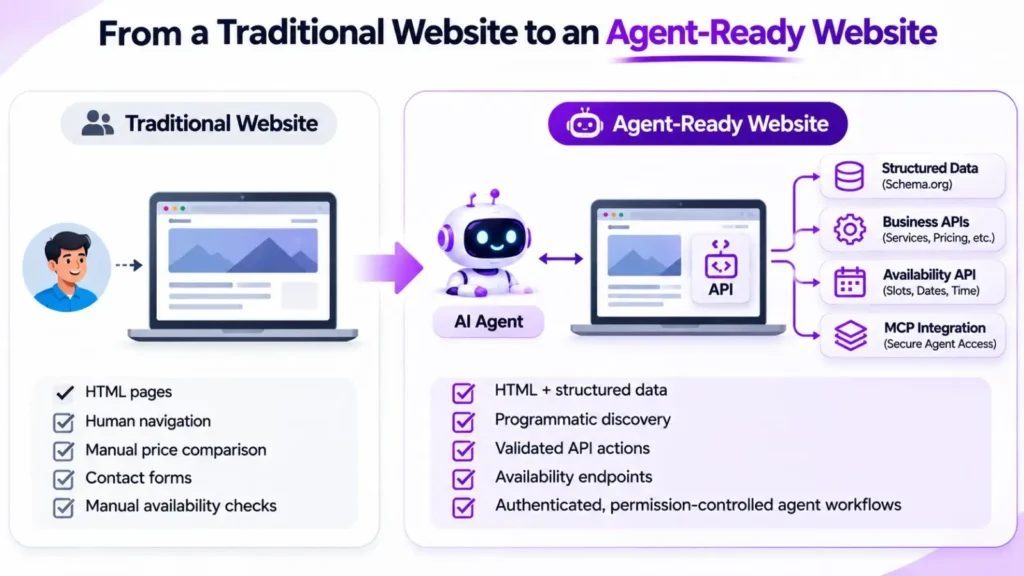
The traditional web is designed for people to navigate pages and complete tasks manually, while the agentic web also allows compatible AI agents to retrieve structured information and interact with approved business tools. This changes how businesses may support discovery, comparison and service requests, while keeping customer authorization and control in place.
**Traditional Human-to-Web Journey
**
• Search for website development companies.
• Open multiple agency websites.
• Compare services and pricing.
• Submit enquiry forms.
• Wait for responses.
**Agent-to-Web Journey **
• Ask an AI assistant to find suitable website development agencies.
• The agent retrieves structured service information and pricing.
• It compares business offerings against the customer’s requirements.
• It checks consultation availability.
• With the customer’s permission, it submits an appointment request through an authorised integration.
The important difference is how information and actions are accessed. A traditional website presents information visually. An agent-ready website additionally exposes selected information and actions through documented, machine-readable interfaces.
| Traditional Website | Agent-Ready Website |
| --- | --- |
| HTML pages and visual navigation | HTML plus structured data and programmatic discovery |
| Manual price comparison | Structured pricing endpoints |
| Contact forms | Validated API actions |
| Manual availability checks | Availability endpoints |
| Browser-driven workflows | Authenticated agent workflows |
## 2.1 AI Search vs. Agentic Web: Why Businesses Need to Understand the Difference
AI-powered search and the agentic web are related developments, but they solve different problems. AI search mainly retrieves, interprets and summarises information; agentic systems can also interact with connected business tools when the user and integration permit those actions.
| AI-powered search | Agentic web interactions |
| --- | --- |
| AI retrieves, interprets and summarises website information. | AI agents can interact with connected business systems and approved tools. |
| Focuses mainly on information discovery. | Focuses on discovery and permitted actions. |
| Crawlability, useful content and SEO fundamentals remain important. | APIs, structured data, authentication, permissions and integrations become important. |
| Example: finding and comparing website development companies. | Example: retrieving service details, checking consultation availability and submitting an enquiry with user approval. |
## 3. What Model Context Protocol (MCP) Means for Business Websites
Model Context Protocol (MCP) is an open protocol that standardises how compatible AI applications connect to external tools, resources and contextual information. It gives clients a consistent way to discover and invoke capabilities exposed by an MCP server.
• Retrieve service information.
• Search product catalogs.
• Check product availability.
• Retrieve pricing information.
• Check appointment availability.
• Create customer enquiries.
• Request bookings with appropriate consent.
MCP complements existing REST APIs; it does not replace databases, business logic or the systems that remain the source of truth. For selected workflow and system integrations, explore our [services and integration capabilities](https://dezhyne.com/services/). It also does not automatically make a website discoverable to AI systems or guarantee that an assistant will use an integration. A compatible client and a correctly implemented server are required.
## 3.1 Stateless Request Handling
The 2026-07-28 MCP specification introduces a stateless protocol core, removing the requirement for protocol-level sessions in Streamable HTTP. Each request carries the necessary protocol metadata, allowing requests to be processed independently across server instances.
However, this does not mean business applications must be stateless. Application-level information, such as booking references, customer workflows and transaction identifiers, can still be maintained through explicit application-managed state.
**3.2 Header-Based Routing**
The specification uses HTTP headers such as Mcp-Method and Mcp-Name so gateways and infrastructure can route or meter requests using operation metadata.
Mcp-Method corresponds to the JSON-RPC method, while Mcp-Name corresponds to the method-specific name, such as a tool name or resource identifier, as applicable. Servers should validate that header values match the corresponding request fields.
**3.3 Cacheable List Responses **
MCP list and resource-read responses can carry cache hints such as ttlMs and cacheScope. These fields help clients determine how long results remain fresh and whether they can be shared safely. Frequently changing information such as inventory or appointment availability still needs an appropriate freshness strategy.
**3.4 Client ID Metadata Documents (CIMD) **
The specification formally moves away from Dynamic Client Registration (DCR) toward Client ID Metadata Documents (CIMD), while retaining DCR for backward compatibility during the transition. This is part of broader authorization hardening; implementations should follow the current specification and compatible authorization-server requirements.
MCP is an interaction layer, not a replacement for a business platform. It does not remove the need for reliable APIs, secure databases, useful website content or human approval for sensitive actions.
## 4. Structuring Machine-Readable Catalogs, Availability Endpoints, and Booking Tools
Machine-readable catalogs and documented APIs allow AI agents and other software to retrieve consistent business information without relying only on webpage presentation. Businesses should expose accurate service, product, pricing and availability data through controlled interfaces connected to their underlying systems.
** 4.1 Machine-Readable Product and Service Catalogs **
A machine-readable catalog allows AI agents to understand what a business offers. For e-commerce websites, important fields include product ID, product name, description, SKU, category, price and currency, variants, stock availability, product URL and shipping information.
For service-based businesses, the structure may include service ID, service name, description, category, starting price, duration, delivery timeline, supported locations and booking requirements.
Example Service Catalog Response
{
“service\_id”: “web-development-001”,
“name”: “Business Website Development”,
“category”: “Website Development”,
“starting\_price”: {
“amount”: 15000,
“currency”: “INR”
},
“estimated\_delivery”: “15-20 business days”,
“availability”: “enquiry\_required”
}
This is an illustrative example. Actual business pricing and delivery information should come from the current business system.
**4.2 Availability Endpoints**
Availability is important for businesses that accept appointments, reservations, consultations or bookings. An AI agent needs a reliable way to retrieve current availability directly from the booking system.
**Example API endpoint**: GET /api/v1/availability?service\_id=consultation&date=2027-02-15
{ “service\_id”: “consultation”, “date”: “2027-02-15”, “timezone”: “Asia/Kolkata”, “available\_slots”: \[ {“start”: “10:00”, “end”: “10:30”}, {“start”: “11:00”, “end”: “11:30”} \] }
The availability service should retrieve live booking information rather than rely on outdated cached data. A previously returned slot should not be treated as a confirmed booking.
**4.3 Booking and Enquiry Tools**
After retrieving availability, an AI agent may need to initiate an action. Each tool should have a narrow purpose and validate its inputs before changing business data.
| Tool | Purpose |
| --- | --- |
| search\_services | Find suitable services |
| get\_service\_details | Retrieve service information |
| check\_availability | Find appointment slots |
| create\_booking\_request | Submit a booking request |
| get\_booking\_status | Retrieve booking progress |
| cancel\_booking | Request cancellation under approved rules |
**4.4 OpenAPI and JSON Schema **
OpenAPI documents HTTP API operations, parameters, authentication requirements and response structures. JSON Schema describes the expected structure and validation rules for JSON data. Together, they help developers build predictable interfaces that applications and AI-related systems can consume. MCP complements these technologies by providing a standard interaction layer; it does not replace existing REST APIs, databases or business logic.
**4.5 Example: Preparing a WordPress Business Website**
• WordPress stores the business’s service descriptions, categories and published information.
• A custom REST API exposes approved service information in a predictable format.
• An MCP server exposes selected functions, such as search\_services, get\_service\_details and create\_enquiry.
• An AI agent retrieves relevant information and presents the proposed enquiry details to the customer.
• After the customer confirms, the request is submitted to the CRM or business system.
• The system returns a reference or status that can be communicated to the customer.
The MCP server should call existing APIs or application services rather than duplicate business logic. Sensitive operations must be authenticated and authorized. See Dezhyne Labs’ services and integration capabilities for related business-system work.
## 5. Authentication, Rate Limiting, and Consent: Letting Authorized AI Clients Act Safely
Agent-facing integrations must distinguish between public information and operations that require authentication, authorization or customer approval. A production-ready implementation should validate every request, limit tool permissions, prevent abuse and record sensitive actions.
**5.1 Authentication and Authorization Authentication**
establishes the identity of the client or user making a request. Authorization determines what that identity is permitted to access or execute.
• Public clients may retrieve publicly available service information.
• Authenticated clients may access customer-specific booking information when authorized.
• Approved integrations may create booking requests within defined scopes.
• Restricted operations may require additional customer confirmation.
Use established authorization mechanisms such as OAuth where appropriate, secure token handling, scoped permissions and HTTPS. Authentication alone does not make an integration safe: every sensitive tool must check the user’s permissions and the requested action on the server.
** 5.2 Validate HTTP Header and Request Body Consistency**
When using MCP header-based routing, servers must validate that the values in HTTP headers such as Mcp-Method and Mcp-Name match their corresponding JSON-RPC request fields. Never rely exclusively on routing headers when authorizing or executing an operation. Reject mismatched or malformed requests to prevent protocol confusion and inconsistent request handling across gateways and backend services.
** 5.3 Rate Limiting and Abuse Prevention **
AI agents may generate multiple API requests within a short period. Without appropriate controls, this can increase server load and create opportunities for abuse.
• Per-client and per-user request limits.
• IP-based abuse detection where appropriate.
• Request validation and payload size limits.
• API gateway restrictions and monitoring.
• Temporary blocking for suspicious traffic.
• Idempotency keys for booking and payment-related actions. An endpoint should recognize repeated submissions with the same idempotency key and avoid creating duplicate bookings.
**5.4 Customer Consent and Action Confirmation**
An AI agent should not automatically assume that retrieving information means it has permission to perform an action.
• Retrieve the requested service.
• Check current availability.
• Present appointment details and applicable pricing.
• Obtain customer confirmation.
• Submit the booking request.
• Return the booking reference and status.
For payments, purchases, cancellations and changes to customer records, require the appropriate authorization and human approval. The exact confirmation flow should match the risk and impact of the action.
**5.5 Protect Business and Customer Data**
Not all business data should be exposed through machine-readable endpoints. Keep customer records, internal pricing rules, supplier details, employee information and confidential business documents behind appropriate access controls.
• **Prompt injection and untrusted content**: treat text returned by external websites, documents and tools as data, not trusted instructions.
• **Tool-level permission boundaries**: give each tool only the permissions required for its task.
• **Server-side authorization**: check access rights on every sensitive operation, not only at login.
• **Credential security**: store secrets securely, restrict access and rotate credentials when required.
• **Audit logging**: record agent-initiated actions with the identity, operation, outcome and relevant reference.
• **Input and platform security**: validate inputs and use protections against injection, request forgery and malformed requests.
An AI agent should receive only the information and permissions required to complete its authorized task.
## 6. Four-Step Readiness Audit for Existing WordPress, Shopify, and Next.js Websites
Businesses do not necessarily need to rebuild their websites to prepare for the agentic web. Existing platforms already provide a foundation through REST APIs, commerce integrations, structured data and authentication mechanisms. The task is to identify what is available, what is missing and which operations should be exposed.
** Step 1: Audit Your Existing Website Data**
Start by checking whether important business information is structured and consistent.
• Product and service catalogs.
• Pricing and currency information.
• Product variants and stock records.
• Booking and appointment information.
• Customer enquiry workflows.
• Business contact information.
• Existing API endpoints.
Check whether the information shown on the website matches the underlying database. Your first priority should be creating a reliable source of truth.
**Step 2: Build or Improve Your API Layer **
Identify the business operations that should be accessible through APIs. You may need endpoints for product searches, service information, pricing, availability and enquiry submission.
** WordPress**
WordPress includes a REST API that can expose posts, pages and custom content types. WooCommerce also provides REST API capabilities for accessing store data and managing supported commerce operations. Custom endpoints can be developed for appointment availability, quotation requests or service catalogs.
**Shopify **
Shopify provides APIs for accessing product and commerce data. Depending on the required customer journey, developers can use Storefront API capabilities for storefront experiences and authenticated Admin API operations for administrative workflows. Inventory, customer, order and checkout access must follow platform permissions and API rules.
** Next.js **
Next.js can provide the application layer for custom API routes and backend integrations. It can connect to databases, CRM platforms, inventory services, payment providers and third-party systems. The goal is not to expose every internal operation. It is to create a controlled interface for the business functions agents genuinely need.
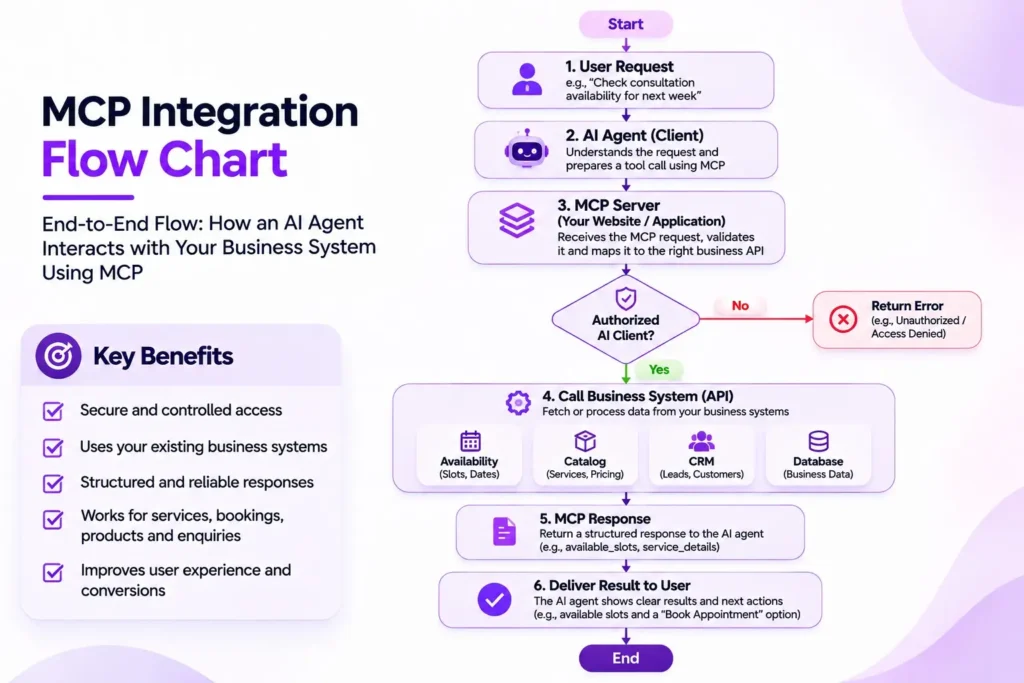
**Step 3: Introduce MCP Integration**
Once the API layer is reliable, determine whether MCP would add value. An MCP server can expose selected business capabilities as discoverable tools and resources.
MCP INTEGRATION FLOW
**Business Website** content + storefront
›
**MCP Server** discovery + routing
›
**Business APIs** existing services
›
**Business Systems** database • CRM • booking
Selected MCP tools call existing APIs; business logic stays in the system of record.
## Step 4: Test Security, Reliability, and Agent Workflows
• Can an agent retrieve the correct service information?
• Does it receive updated pricing?
• Can it distinguish unavailable products from available products?
• Does the booking system prevent duplicate requests?
• Can an unauthorized agent access customer records?
• Are sensitive operations protected by appropriate confirmation?
• Can the infrastructure handle multiple concurrent requests?
• Are errors returned in a predictable format?
Also test expired credentials, rate limits, malformed requests and failed downstream services. A website should be considered agent-ready only when its data, actions, security and error handling work reliably together. For help validating these workflows, explore Dezhyne Labs’[ software QA services](https://dezhyne.com/services/software-qa-services/).
## 7. What Does an Agent-Ready Website Architecture Look Like?
A practical agent-ready architecture does not require replacing your existing website or database. Instead, it introduces an integration layer between AI applications and the business systems that already power your website.
CROSS-CUTTING CONTROLS
1 AI Assistants / Agents Compatible clients
2 Authentication & Authorization Identity • Scopes • Consent
3 MCP Server Tool discovery • Request handling
4 Selected Capabilities Catalog • Pricing • Booking
5 Business API Layer Validation • Business rules
6 Business Systems Website • CRM • E-commerce
7 Database Systems Authoritative records
The architecture should include rate limiting, monitoring, validation and permission checks at the appropriate boundaries. Sensitive actions must be checked by the business API or application service before they are completed.
For businesses already using WordPress, Shopify or Next.js, this approach allows agent-facing capabilities to be introduced incrementally. The existing website remains the human-facing experience, while APIs and MCP provide a controlled interface for machine-driven interactions.
## 8. How Much Does It Cost to Make a Website Agent-Ready?
There is no universal price for making a website agent-ready. The cost depends on the current website, the quality of data, the maturity of its APIs, the number of integrations and the security requirements. Some businesses may need only structured content and a reliable enquiry workflow; others may need substantial platform and integration work.
| Website type | Typical work involved |
| --- | --- |
| Informational business website | Content and data structuring, relevant schema, basic API capabilities and enquiry workflow improvements. |
| E-commerce website | Product catalog and inventory APIs, pricing and variant data, order-related integrations and permission controls. |
| SaaS platform | Customer-specific APIs, authentication, MCP tools, workflow integrations, monitoring and extensive testing. |
**Main Cost Factors **
• Existing website platform and architecture.
• Quality and consistency of business data.
• Availability and maturity of existing APIs.
• Number and complexity of third-party integrations.
• MCP server development and hosting, if needed.
• Authentication, authorization and security requirements.
• Testing, monitoring, maintenance and future changes.
A simple informational website may need little more than structured content and reliable enquiry handling. An e-commerce or SaaS platform may require more substantial integration work. Start with the business outcome and build only the capabilities that support it.
## 9. Do All Businesses Need an MCP Server in 2027?
Not necessarily. MCP is useful when a business wants to make its services, data or actions discoverable and accessible to compatible AI applications through a standard protocol.
However, building an MCP server simply because it is a new technology can create unnecessary development and maintenance costs.
A small business with a simple informational website may benefit more from accurate content, structured data, well-designed contact forms and a reliable REST API.
An e-commerce business with product discovery, inventory and order-related workflows may have stronger reasons to invest in agent-facing integrations.A SaaS platform with customer-specific operations or automated workflows may benefit from an MCP server that exposes selected capabilities securely.
The best strategy is to identify actual business use cases first and choose the integration architecture accordingly.
## 10. Preparing for the Agentic Web: What Businesses Should Do Now
The agentic web is not a replacement for traditional websites. It is an additional way for customers and software agents to interact with business systems.
• Improve Data Quality. Maintain accurate product, service, pricing and availability information.
• Adopt API-First Architecture. Make important business operations accessible through documented APIs.
• Introduce Machine-Readable Schemas. Use structured responses, OpenAPI and JSON Schema.
• Implement Secure Integrations. Establish authentication, permissions, consent and rate limiting.
• Evaluate MCP Adoption. Expose relevant business tools through MCP when there is a genuine use case.
The biggest mistake would be investing in an MCP integration while leaving the underlying business data inconsistent or the existing APIs unreliable.
The agentic web represents an important evolution in how customers and AI applications interact with digital businesses. Preparing for this shift does not require every business to immediately adopt MCP or rebuild its website.
It requires a reliable foundation of structured business data, documented APIs, secure integrations and clearly defined permissions. Businesses that build this foundation today will be better positioned to support emerging AI-driven customer experiences.
Is Your Website Ready for the Agentic Web?
AI agents are changing how customers discover businesses, compare services and interact with digital platforms. Dezhyne Labs helps businesses modernise their websites with API integrations, AI automation and agent-ready architecture. Whether you operate a WordPress website, Shopify store or custom Next.js application, an initial readiness assessment can identify practical integration opportunities.
[ REQUEST A WEBSITE READINESS ASSESSMENT](https://dezhyne.com/contact/)
## Frequently Asked Questions
Do small business websites need an MCP server in 2027?
No. Small business websites do not automatically need an MCP server. Businesses with simple informational websites can begin with accurate structured content, schema markup and reliable APIs. MCP becomes more valuable when AI applications need to discover and interact with business tools, such as product searches, appointment availability and booking workflows.
How does MCP differ from a standard REST API?
A REST API exposes application data and operations through HTTP endpoints. MCP provides a standard protocol through which compatible AI applications can discover and interact with tools, resources and other capabilities. MCP can use existing business APIs behind the scenes, so the two technologies complement each other rather than compete.
How do you prevent AI agents from submitting spam bookings?
Use authenticated access, permission scopes, rate limiting, request validation, CAPTCHA or other risk-based verification where appropriate, idempotency keys and customer confirmation for consequential actions. Booking endpoints should validate availability against the live booking system and record every agent-initiated transaction.
Can WordPress or Shopify sites become agent-ready without a full rebuild?
Yes. Existing WordPress and Shopify websites can often be extended using their existing APIs, custom endpoints, structured data and secure integration layers. An MCP server can then expose selected capabilities to compatible AI applications. The amount of development required depends on the website’s current architecture and business requirements.
Can an AI agent directly access my website's database?
No. AI agents should not receive unrestricted direct access to a business database. They should interact through controlled APIs or MCP tools that enforce authentication, authorization, input validation and permission boundaries. This allows businesses to expose selected information and operations without exposing sensitive internal records.
## Technical References
1. Model Context Protocol Specification, 2026-07-28 – [official specification](https://modelcontextprotocol.io/specification/2026-07-28)
2. MCP 2026-07-28 Release Notes – [release notes ](https://blog.modelcontextprotocol.io/posts/2026-07-28/)
3. OpenAPI Specification – [OpenAPI](https://spec.openapis.org/oas/latest.html)
4. JSON Schema Specification – [JSON Schema](https://json-schema.org/specification)
5. WordPress REST API Authentication – [WordPress documentation ](https://developer.wordpress.org/rest-api/using-the-rest-api/authentication/)
6. WooCommerce REST API Authentication – [WooCommerce documentation](https://developer.woocommerce.com/docs/apis/rest-api/authentication)
7. Google Search Central: AI Features and Your Website – [Google Search ](https://developers.google.com/search/docs/appearance/ai-features)
Central 8. Google Search Central: Structured Data Introduction – [structured data guidance](https://developers.google.com/search/docs/appearance/structured-data/intro-structured-data)